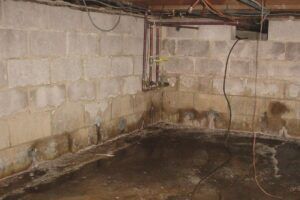
Understanding Bowed Basement Walls
Common Causes of Bowed Basement Walls
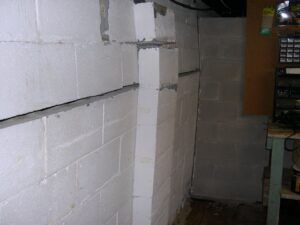
Risks Associated with Bowed Basement Walls
Effective Solutions for Bowed Basement Walls
Wall Anchors
- Excavating the soil around the affected area of the foundation.
- Installing anchor rods through small holes in the bowing wall.
- Securing wall plates on the interior side of the wall.
- Connecting the anchor rods to earth anchors installed outside the foundation.
- Gradually tightening the anchors to stabilize the wall and prevent further bowing.
Carbon Fiber Reinforcement
- Preparing the wall surface by cleaning and removing any loose material.
- Applying a high-strength epoxy to the wall surface.
- Affixing carbon fiber strips to the epoxy-coated surface.
- The carbon fiber strips are anchored at the top and bottom of the wall, providing continuous support.
Steel I-Beams
- Excavating the soil around the affected area to expose the wall.
- Installing vertical steel I-beams against the bowing wall.
- Securing the I-beams to the foundation floor and overhead structure.
- Adjusting the I-beams to apply continuous pressure against the bowing wall, providing immediate support.
Reinforced Concrete
- Excavating the soil around the affected area to expose the wall.
- Forming and pouring a new reinforced concrete wall in front of the existing bowed wall.
- Using rebar and additional reinforcement to ensure the new wall is structurally sound.
Waterproofing and Drainage
- Installation of a sump pump to remove water that accumulates in the basement.
- Properly functioning exterior drainage systems, such as French drains, to redirect water away from the foundation.
- Application of exterior waterproofing coatings to the foundation walls to prevent moisture infiltration.